Goughs post-budget evening offers practical guidance for a changing landscape
On Wednesday, 7th January 2026, Wiltshire-based Goughs Solicitors welcomed local professionals, business owners, and families to the Hartham Park estate in Corsham for a Post-Autumn Budget event.
Delivered in partnership with Fidelius Wealth Management and Pearson May Accountants, the evening provided timely, practical insight into Rachel Reeves’ November Budget and what it means for legal, financial, and business planning as we move into 2026.
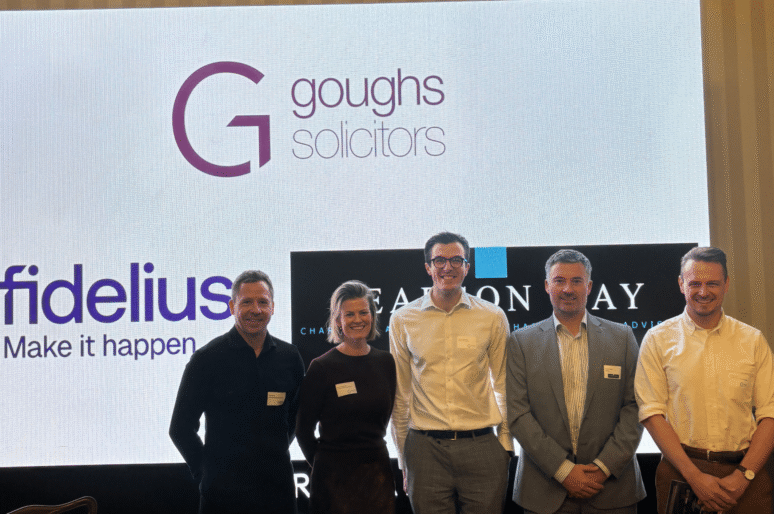
With inheritance tax, succession planning, and rising costs dominating headlines, the event was designed to cut through uncertainty and offer clarity. An expert panel comprising Phillip Bolton, Andrew Langbridge, and Gemma Broadbent of Goughs Solicitors, alongside Martin Bridle of Pearson May Accountants and Chris Bence of Fidelius Wealth Management, delivered focused presentations followed by a lively Q&A and networking session.
Inheritance Tax: the dominant concern
Unsurprisingly, inheritance tax (IHT) emerged as the topic of greatest interest among attendees. Questions flowed throughout the evening, particularly on gifting, pensions, agricultural relief, and how families and business owners should plan ahead.
Andrew Langbridge, Private Client Solicitor at Goughs, provided clear guidance on the fundamentals of lifetime gifting as a core IHT planning strategy. He explained the well-known seven-year rule, along with commonly used exemptions that remain available, including the £3,000 annual gifting allowance, small gifts of £250, gifts on marriage or civil partnership, and gifts made from surplus income.
Many audience questions focused on practical scenarios such as paying grandchildren’s school fees, highlighting a strong appetite for reassurance about what is permissible and how to gift effectively without unintended tax consequences. Andrew also addressed the role of trusts in estate planning, emphasising that while they remain a valuable tool, careful advice is essential to ensure they are used appropriately in the current climate.
Agricultural and business property relief reforms – it’s time to act
Another area of heightened interest was the reform of agricultural and business property relief, with Goughs strongly urging businesses and farming families to take action now. Goughs explained that from 6th April 2026, the previously unlimited 100% relief will be capped at £2,500,000 per person.
Anything above that threshold would qualify for 50% relief only.
The Chancellor’s announcement that this allowance will be transferable between spouses and civil partners, much like the nil rate band, was welcomed news for farming families. This change will bring comfort to married couples and civil partners, particularly where farm assets are not owned equally, and to widows and widowers who will be able to claim a late spouse’s unused allowance even if they died before April 2026.
However, Goughs cautioned that the reforms still represent a significant reduction in relief overall.
With just three months left for business owners and farming families to act before the rules change, estate planning, ownership structures, and succession strategies urgently need review, and this is not a farming-only problem. These changes will hit family-owned manufacturers, wholesalers, retailers, rural enterprises, and owner-managed businesses across every sector and region of the UK. Farms worth more than £6 million, and those owned by single individuals or cohabiting families, will feel the impact most acutely. The clear message was that proactive estate planning has never been more important.

Succession planning and the future of EOTs
Gemma Broadbent, Partner and Head of Corporate & Commercial at Goughs, focused on business succession planning and the changing landscape for employee ownership trusts (EOTs). EOTs have long been viewed as a highly tax-efficient exit route, offering capital gains tax relief for selling shareholders while promoting employee engagement and continuity.
However, the Autumn 2025 Budget reduced CGT relief on disposals to EOTs from 100% to 50%. While the relief has not been removed entirely, the change has prompted many business owners to reconsider whether EOTs remain the right option for them.
Gemma outlined key actions business owners should consider before April to secure existing reliefs where possible and encouraged early planning. She also explored alternative exit strategies and succession routes, emphasising that no single solution fits all businesses.
Despite the challenges, Gemma struck an optimistic tone. Working with businesses from start-ups to large corporations, she is seeing companies adapt creatively to new pressures. She also noted a rise in families transferring estates to children earlier as part of IHT planning, a strategy that brings its own challenges, but often delivers unexpected benefits too.
Rising costs, cashflow and workforce pressures
Martin Bridle of Pearson May Accountants recapped the main corporation and income tax considerations from Budget 2024 through to Budget 2025, with a particular focus on owner-managed businesses. He addressed property ownership, incorporation considerations for 2026 and the continued relevance of salary sacrifice for pension contributions.
Attention then turned to rising employment costs. From April 2026, the national minimum wage for over-21s will rise by 4.1% to £12.71 per hour, with even larger percentage increases for younger workers. For labour-intensive sectors such as hospitality, retail and care, this presents a significant challenge.
There was cautious optimism around the Chancellor’s £725m apprenticeship support package, including fully funded apprenticeships for eligible young people in SMEs, which could help address skills shortages while managing costs.
Pensions and inheritance tax: a major shift ahead
Chris Bence, Chartered Financial Planner at Fidelius, addressed one of the most significant long-term changes announced: the inclusion of pensions within estates for IHT purposes from April 2027. This marks a major shift, as pensions have historically been a powerful way to pass on wealth outside the IHT net.
Under the new rules, pension values will be included when calculating the overall estate, potentially bringing an estimated 10,000 additional estates into the IHT regime in 2027/28 alone. Chris outlined the likely impact on beneficiaries and discussed mitigation strategies, including insurance planning and lifetime gifting.
The overriding message: plan early, seek advice
Across the evening, one theme was consistent: early, joined-up planning is essential. Whether navigating inheritance tax, succession planning, workforce pressures or rising costs, the advice from Goughs and its partners was clear: start talking and strategizing.
With further changes on the horizon, reviewing estate plans, business structures, and financial strategies now will put individuals and businesses firmly in the driving seat for 2026 and beyond.
Pictured: (Top of page) Cutting through uncertainty: the speakers at the post-budget event (Image: Ollie James)