Goughs apprentices prove university isn’t the only route into law

As young people across the country consider their next steps following the recent A-level results, three apprentices at Wiltshire-based Goughs Solicitors are showing that a career in law doesn’t have to begin with the traditional route of studying for a law degree at university.
A-Level Results Day brings with it one very big question: what next? For young people interested in professional careers such as law, the traditional answer can seem obvious. Get the grades, go to university and start thinking about how to secure that first job in the profession.
Daisy, Liberty and Millie all came into law from very different starting points. None studied law at A Level, and none followed the traditional university-to-law-firm route. Instead, they are building their careers as solicitor apprentices, earning while they learn and gaining hands-on experience working alongside experienced lawyers.
Their stories challenge not only assumptions about how you become a lawyer, but also some of the perceptions that still surround apprenticeships themselves…
From medicine to tax and estate planning
At 18, Daisy was certain about her future, and it wasn’t law.
She studied Biology, Chemistry and Spanish at A Level with plans to become a doctor.
After the disruption surrounding university admissions during Covid, her university place was deferred for a year. That unexpected gap gave Daisy a taste of working life and independence before she eventually went to university. When she did, she realised medicine wasn’t the career she wanted after all.
“At 18 I was convinced I was going to work in medicine,” said Daisy. “Then suddenly I was at university realising that the career I’d planned for myself wasn’t actually what I wanted. That’s quite daunting when you’ve spent years working towards something.”
Daisy began looking at other possibilities and came across an advert for a Legal Assistant role at Goughs on Indeed. She applied, secured an apprenticeship place and is now working in her seat in private client law, where she has developed a particular interest in tax, estate planning and wealth management.
“What appealed to me was that I could actually get into a firm, work alongside people who were already doing the job and learn through real experience. I didn’t have to wait several more years before discovering what working in that profession was actually like.”
Perhaps the biggest surprise has been discovering an area she genuinely loves.
“I wasn’t aware of the scope within the many different areas within law. Tax, estate planning and wealth management were completely new to me, but that’s been part of what has made it so interesting. I’ve really enjoyed building my knowledge and discovering an area of private client law that I find fascinating.”
Daisy’s experience is a useful reminder on Results Day that the subjects someone chooses at 16 or 17 don’t have to determine their entire career.
She added, “Changing direction doesn’t mean you’ve failed. Sometimes you have to experience something to realise it isn’t right for you. My route wasn’t the one I planned, but I’ve ended up in a career I genuinely thrive in.”
What can Theatre Studies teach you about being a lawyer?
Liberty’s route into law was different again. She studied English Literature, Theatre Studies and History at A Level and had secured a place at the University of Exeter. Having completed her A-Levels during the Covid-19 pandemic, Liberty decided that it wasn’t the right time for her to head off to University. After taking a gap year and learning about working full time, she chose instead to explore other ways of building her career that didn’t depend on the traditional university route.
Keen to start progressing professionally while continuing her education, Liberty discovered the solicitor apprenticeship at Goughs through the firm’s website. And while this might not seem like the most obvious preparation for a career in law, Theatre Studies has proved to be one of the most valuable subjects she studied.
“People probably don’t hear ‘Theatre Studies’ and immediately think ‘future solicitor’, but I use those skills all the time,” said Liberty. “Standing up and presenting, having the confidence to speak to different people, reading a situation and thinking on your feet, they are incredibly relevant.”
Her experience has also changed her perception of what makes someone good at law.
She continued, “Obviously you need the legal knowledge, but so much of being a good lawyer comes down to life skills. Can you listen? Can you explain something complicated so somebody understands it? Can you make someone feel comfortable enough to tell you what’s really worrying them? Can you adapt the way you communicate depending on the person in front of you?”
Liberty now particularly enjoys working with vulnerable clients, including matters involving Deputyships and Lasting Powers of Attorney — an area with personal significance because her grandmother is in a care home.
“When you’re working with vulnerable clients, you’re not dealing with a textbook scenario, you’re dealing with somebody’s life. They might be worried or overwhelmed. Knowing the law matters enormously, but how you communicate that law matters too.”
For Liberty, this is where the apprenticeship model comes into its own because she is acquiring the academic and technical knowledge required to become a solicitor while simultaneously seeing how experienced lawyers apply it in practice.
Her advice to anyone now weighing up their own next steps on A-Level Results Day is not to feel pressured into following a particular path.
She said, “At 18, it can feel as though you have to have everything figured out and make the ‘right’ decision about your future. But you don’t. Choose something you’re passionate about, think about what will make you happy and remember that life at 18 isn’t ending – it’s really only just beginning.”
Earning while learning: Buying a home at 21
Millie studied Fine Art, English and Biology A levels. With a natural aptitude for English and a strong work ethic, Millie felt that a degree apprenticeship would play to her strengths and suit both her skills and personality.
She explained, “I think we need to move away from the idea that if you’re ambitious, you go to university, and if you’re practical, you do an apprenticeship. I was ambitious about building a professional career, but I also wanted to learn through real experience. A degree apprenticeship gave me the opportunity to do both.”
Millie is now working in residential property, where she has embraced the fast-paced and dynamic nature of the work. She has also been surprised by how quickly she has been able to get involved in real caseloads and put what she is learning into practice.
“You get stuck in surprisingly quickly. You’re dealing with real work and real caseloads, and that makes you learn fast because what you’re doing actually matters. You’re working and studying at the same time, so it’s definitely not a walk in the park. But when I learn something, I can see where it fits. And if I don’t understand something, I’ve got experienced lawyers around me who I can learn from.”
For Millie, that has meant achieving a degree of financial independence at a young age. At just 21, she has already bought her own home with her partner.
“Buying my own house at 21 is something I’m really proud of and is one of my biggest achievements. I was able to buy my house at 21 due to starting my degree apprenticeship at a young age and I am forever grateful for this opportunity.”
Considering the various routes to law
A solicitor apprenticeship typically takes six years. During that time, apprentices are embedded within a law firm, working with experienced lawyers and developing the practical skills needed in the profession.
That means that by the time they reach the later stages of their training and qualification, they can already have years of workplace experience behind them.
Daisy believes that is one of the route’s most valuable and sometimes overlooked advantages.
“When graduates first come into a firm, they may have fantastic academic knowledge, but we’ve already had years of experience of how a law firm actually works. Speaking to clients, managing work, working with different teams and seeing how legal problems play out in real life. In that sense, you can feel much further ahead in terms of practical workplace experience.”
It doesn’t mean apprentices are “better” lawyers than graduates. Nor does it diminish the knowledge, independence and broader experiences that university can provide.
It means the two routes develop people differently. For many aspiring lawyers, a degree will remain exactly the right choice. Goughs recruits and encourages graduates too, and those graduates do not have to have studied law. A history, science, languages, arts or other degree can develop perspectives and skills that prove enormously valuable within the profession.
What actually makes a good lawyer?
The experiences of the three apprentices also raise a broader question about how we define potential. Law undoubtedly requires intellectual ability. Solicitors need extensive legal knowledge, sound judgement and rigorous professional training.
But legal practice requires something else too.
Communication. Curiosity. Empathy. Confidence. Resilience. Creativity. Problem-solving. The ability to understand what somebody is really asking for and explain a complicated situation clearly. These aren’t necessarily skills measured by an A-Level grade.
You don’t have to have studied law. You don’t have to have chosen traditionally “academic” subjects. And choosing an apprenticeship doesn’t mean lowering your ambitions.
If you’re curious, enjoy working with people, communicate well, ask questions, think creatively and like solving problems, a legal career could be worth considering, whether your next step is a university lecture theatre or your first day in a law firm.
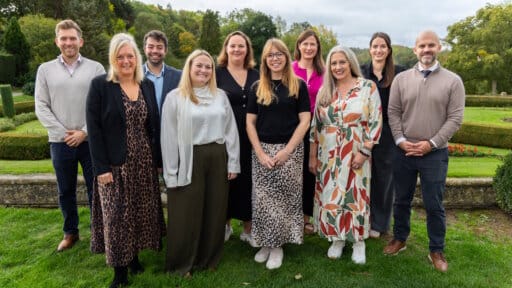
Pictured: (left to right) Goughs apprentices Millie, Daisy and Liberty